



What to Look for in a Commercial Plumbing Contractor in Omaha
If you were managing a commercial property during the January 2024 cold snap, when Omaha temperatures plunged to -16°F and stayed below zero for over 75 straight hours, you know exactly how fast plumbing systems can fail. Pipe bursts spiked across the metro that week. The contractors who had the bench depth to respond quickly saved their clients thousands in damage and days of downtime. The ones who didn’t? They left building managers scrambling for weeks.
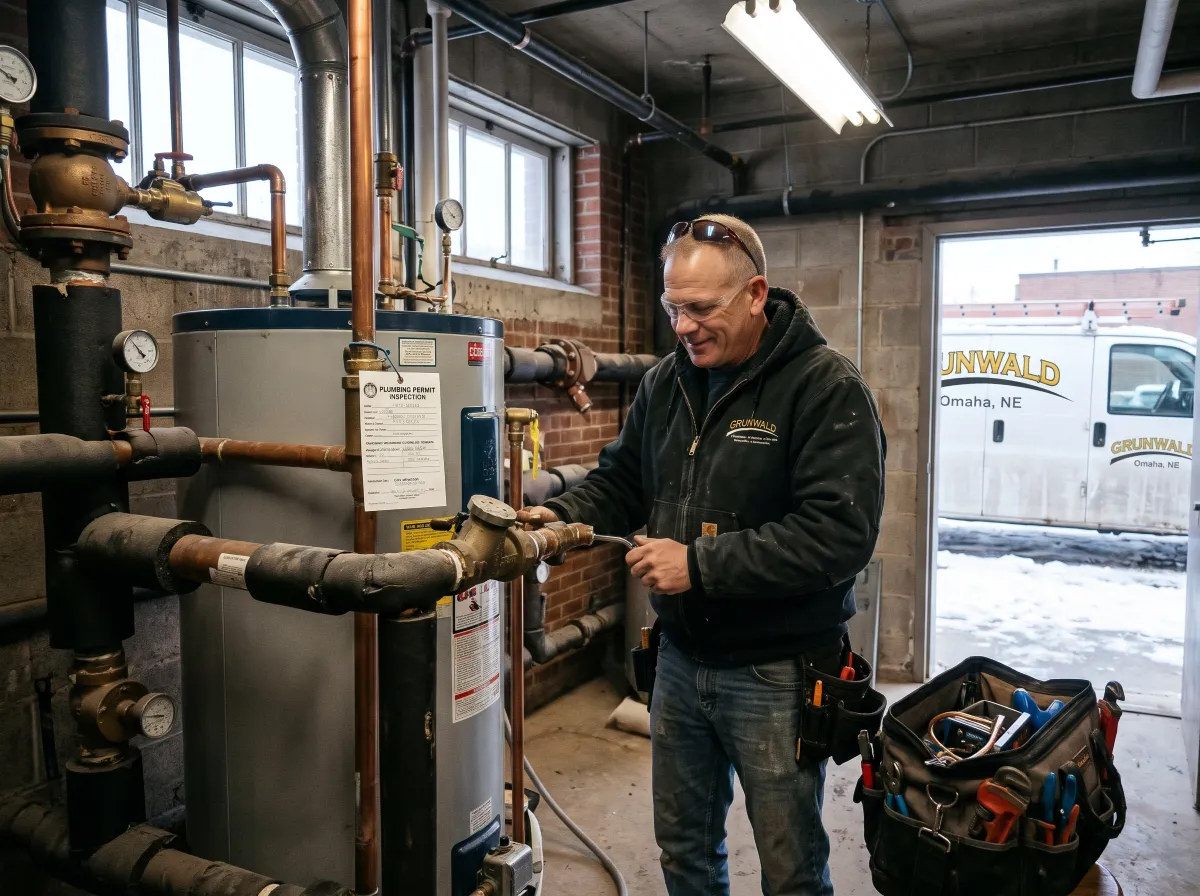
Two winters past, we got a call from a multi-tenant office building in Lincoln’s Haymarket district. A water heater had failed during that same cold snap. Tenants were without hot water for three days because the building manager had hired a residential plumber who didn’t have the capacity to handle a commercial system – or the licensing to work in Omaha at all. We had a crew on site within 4 hours, replaced the commercial-grade 100-gallon unit, and had the building back up before the next business day. That building manager now has us on speed dial – and a much better understanding of why residential and commercial plumbing aren’t the same thing.
Key Factors in Choosing a Commercial Plumbing Contractor
The best moment to choose a commercial plumbing contractor is before an emergency happens, not during one. Here’s what actually matters when you’re deciding who gets the call.
Licensing: City and State Are Not the Same Thing
Nebraska handles plumbing licensing differently than most states, and it trips up a lot of property owners. Plumbing licenses in Nebraska are issued locally rather than through a single statewide board – the City of Omaha Planning Department maintains its own Plumbing Board, separate from Lincoln’s Building and Safety Department. A plumber licensed in one Nebraska city isn’t automatically authorized to work in another, so a contractor’s credentials need to specifically cover Omaha.
If a contractor says “we’re licensed in Nebraska,” ask specifically about Omaha. The City of Omaha Plumbing Board has its own examination process and continuing education requirements – and we’ve seen contractors from Lincoln or Grand Island assume their license travels. It doesn’t. A contractor who has to get their Omaha license sorted out after the fact isn’t a contractor you want handling your emergency.
On top of city-level trade licensing, plumbing businesses that annex materials to real property – meaning most commercial installation and repair work – are required to register with the Nebraska Department of Labor’s Contractor Registration Database before performing any work in the state. This registration also determines how the contractor handles sales and use tax on building materials, and it has to be renewed annually. A contractor who isn’t registered isn’t just cutting a corner; using one can expose your business to withholding liability under Nebraska’s Contractor Registration Act.
Ask directly: is your Omaha city license current, and are you registered with the state’s Contractor Registration Database? A legitimate commercial plumbing contractor will answer both questions without hesitation. We’ve seen property managers get burned by contractors who had one but not the other – and the city can and will shut a job down mid-project if the paperwork isn’t right.
Insurance and Bonding
Licensing tells you a contractor is qualified to do the work. Insurance tells you what happens if something goes wrong anyway. Commercial plumbing jobs carry real exposure – a failed backflow preventer or a mishandled sewer line can mean flooded inventory, halted operations, or a code violation that shuts a business down.
At minimum, a commercial plumbing contractor should carry general liability insurance and workers’ compensation coverage. Master plumbing contractors doing business in Omaha typically carry a license bond as part of their city credentialing, and larger commercial projects may call for higher liability limits than a residential job would ever require.
Don’t just take a contractor’s word for it. Ask for a certificate of insurance naming your business, and verify it’s current – not a policy that lapsed last quarter. A contractor who’s reluctant to produce documentation is telling you something important. We’ve been called in to finish jobs where the previous contractor’s insurance had lapsed, leaving the property owner exposed when a water line broke during installation. That’s a headache nobody needs.
Commercial-Specific Experience
A plumber who’s excellent at residential service calls isn’t automatically equipped for commercial work. Commercial systems involve larger supply lines, grease interceptors, backflow prevention devices, multi-fixture restrooms, boiler and water heater systems sized for continuous demand, and code requirements tied to occupancy type. A restaurant, a medical office, and a warehouse each have different plumbing needs – and different regulatory obligations.
Ask a prospective contractor how much of their business is commercial versus residential, and ask about specific project types similar to yours. Have they worked on commercial kitchens? Healthcare facilities? Industrial buildings? Multi-tenant properties? A contractor who mainly handles house calls may still be a fine plumber, but that’s not the same skill set as managing a commercial tenant improvement or an emergency at a facility that can’t afford to close.
We’ve seen it happen: a building manager hires a residential plumber to handle a commercial kitchen renovation, assuming plumbing is plumbing. Two months later, the grease interceptor is undersized, the health inspector is asking questions, and the plumber is nowhere to be found. Commercial work requires commercial experience – plain and simple.
Professional Affiliations Signal Accountability
One of the more overlooked ways to evaluate a contractor is membership in industry associations. Groups like the Mechanical Contractors Association of Omaha (MCA-Omaha) and the Plumbing-Heating-Cooling Contractors Association (PHCC) require members to meet standards around training, safety, and business practices. They also connect contractors to ongoing code education and apprenticeship programs.
MCA-Omaha has been a fixture in this market since the 1950s. Their apprenticeship program is one of the few in the state registered under the DOL Bureau, which means their members’ journeymen have actually gone through formal training – not just “learned on the job.” A contractor active in these organizations is plugged into the local trade community, aware of code changes as they happen, and has more at stake reputationally than one operating in isolation.
It’s not a guarantee of quality, but it’s a meaningful signal – and it’s an easy thing to ask about directly during a bid conversation.
Response Time and Nebraska’s Weather Extremes
Nebraska’s climate is genuinely rough on plumbing systems, and it directly affects how fast help is available when you need it. Winter cold snaps regularly bring sub-zero temperatures that freeze and split exposed or poorly insulated pipes. Summer brings heavy thunderstorms and flash flooding that can overwhelm drainage and sewer systems. Both seasons drive spikes in emergency call volume across the Omaha and Lincoln metro areas.
The contractors with the deepest bench of technicians – and the most established emergency dispatch process – are the ones who can actually reach you quickly when a hard freeze hits or storm sewers back up.
Ask any contractor you’re vetting how they staff for seasonal surges and what their actual guaranteed response window looks like for commercial emergencies, not just standard service calls. A contractor who treats 24/7 emergency service as a real operational commitment, rather than a line on their website, is the one worth having on retainer before the next cold snap or storm rolls through.
References From Comparable Properties
Ask for references – and specifically ask for ones from properties similar to yours. A restaurant, a medical building, a retail center, and an industrial facility all have different plumbing needs and different operational constraints. A homeowner testimonial doesn’t tell you much about how a contractor performs on a commercial tenant buildout or manages a multi-day project around a business’s operating hours.
If you’re managing a property in Omaha’s Old Market district, where many buildings are historic, ask specifically: “Have you worked on historic properties in Omaha before?” The city’s historic preservation requirements can affect plumbing work in ways that newer buildings don’t require. A contractor who doesn’t know that will be in for a surprise – and so will you.
When you call references, ask about communication, whether the project stayed on budget, and how the contractor handled anything that went wrong. Every contractor has had a job go sideways at some point; how they responded matters more than whether it happened at all.
Putting It All Together
Choosing a commercial plumbing contractor in Omaha comes down to verifying a handful of concrete things:
- Current city licensing and state contractor registration
- Adequate insurance (and proof of it)
- Real commercial project experience
- Active industry involvement
- A credible emergency response plan built for Nebraska’s weather swings
- References who can vouch for the work on properties like yours
None of these are hard to ask about, and a contractor confident in their standing will have straightforward answers ready. A contractor who hedges, deflects, or promises to “get back to you” on any of these? That’s a red flag worth paying attention to.
We’ve been keeping Omaha- and Lincoln-area businesses running since 1899 – through wars, recessions, and the kind of winter storms that make plumbers earn their pay. We know the city’s licensing, we know the inspections, and we know how to keep your building’s plumbing running through Nebraska’s worst weather.
If you’re evaluating contractors for an upcoming project – or if you want a second opinion before a small issue becomes a costly one – give us a call. We’ll walk your property, talk through what your building actually needs, and give you a quote that reflects the reality of commercial work in Omaha, not a residential price that doesn’t match the scale of the job.