
How Much Does Furnace Repair Cost in Omaha?
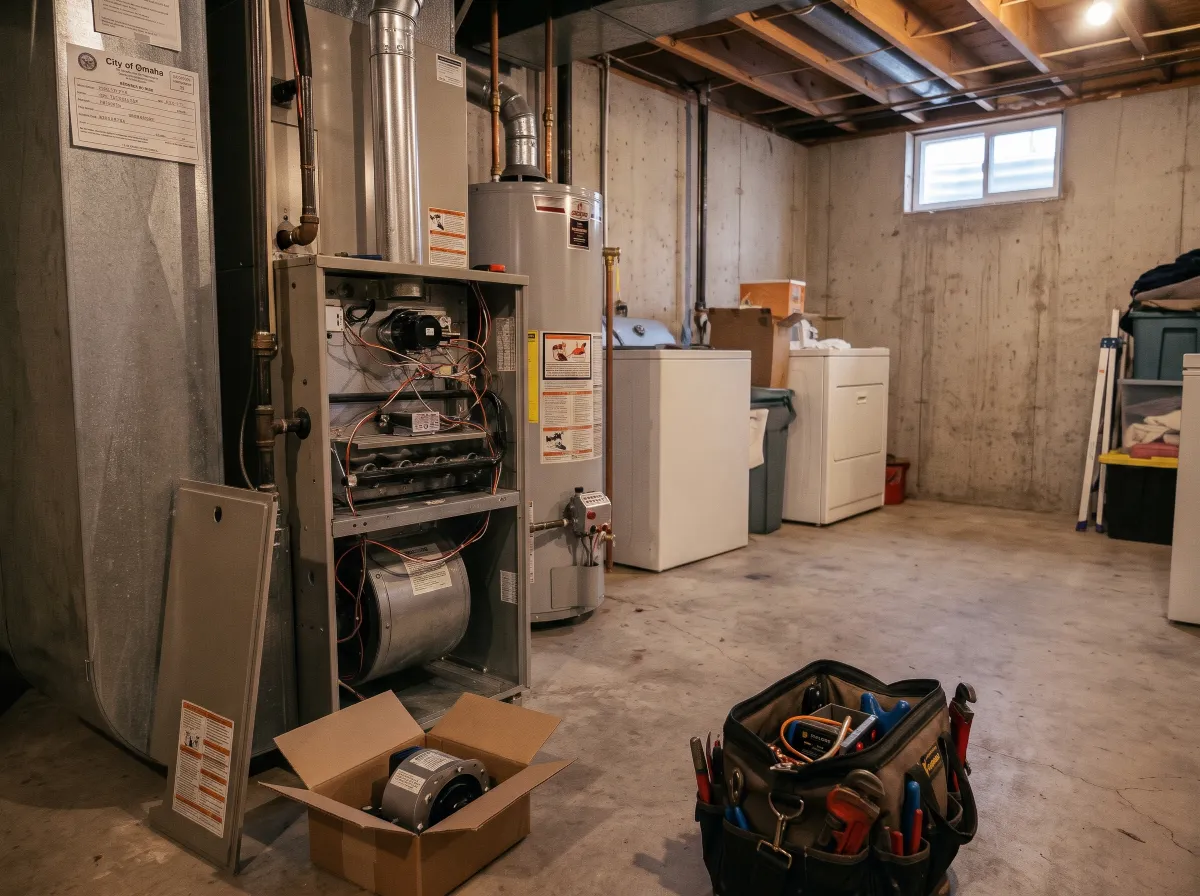
A furnace failing in July is an inconvenience anywhere. A furnace failing during a January cold snap in Omaha is an emergency – and the difference shows up in the bill. We get calls every winter from homeowners surprised that a repair costs more at 2 AM during a hard freeze than it would have on a mild October afternoon for the exact same part. The part didn’t change. The circumstances did.
That’s the honest answer to questions regarding furnace repair cost in Omaha: it all depends on which component failed, when it failed, and how hard your furnace has been working. Below is a breakdown of what Omaha homeowners typically pay by repair type, along with the local factors that push costs up or down.
What Actually Drives the Cost: Labor vs. Parts
Every furnace repair bill is really two numbers combined – the cost of the part itself and the cost of the labor to diagnose and install it. For smaller components like a flame sensor or capacitor, labor is usually the bigger share of the total, since the part itself might cost $20 to $50 while the technician’s diagnostic time and service call make up the rest. For major components like a heat exchanger, the math flips: the part is expensive on its own, and the labor to access and replace it – often a multi-hour job – adds significantly more on top.
This is why two furnaces with the “same” failed part can end up with different bills. A furnace with easy service panel access costs less to repair than one buried behind ductwork in a tight mechanical closet. Age matters too – a 15-year-old furnace may need a part that’s harder to source, which adds time and cost that a newer, more common model wouldn’t.
Furnace Repair Costs in Omaha by Component
These ranges reflect standard, non-emergency service pricing. Where your repair lands within a range depends on your specific furnace model, part availability, and accessibility – which is exactly why an in-person diagnostic matters more than a phone estimate.
Why Minor Fixes Are the Most Common Call
Flame sensors, ignitors, and capacitors fail more often than any other furnace component, largely because these are wear items – parts designed to handle repeated cycling, but not indefinitely. A flame sensor accumulates carbon buildup over a season of regular use and eventually stops reading the flame correctly, causing the furnace to shut off shortly after starting. An ignitor, especially the hot-surface type common in modern furnaces, is a ceramic element that degrades from thermal cycling and typically needs replacement every several years.
The good news is that these are also the fastest and least expensive repairs on the list. A technician can usually diagnose and resolve a flame sensor or ignitor issue in under an hour, and it’s often the first thing checked on a no-heat call, since it’s the most statistically likely cause.
When a Repair Signals a Bigger Problem
Moderate and major repairs – a failed control board, gas valve, blower motor, or draft inducer – usually mean the furnace has been running hard, is getting older, or has an underlying issue that hasn’t been addressed. A blower motor working overtime because of a clogged filter, for example, wears out faster than one that’s been properly maintained.
A cracked heat exchanger is the repair that deserves the most caution. It’s not just the most expensive line item – it’s a safety issue, since a cracked exchanger can allow carbon monoxide into the air supply. On an older furnace, a heat exchanger failure is often the point where replacing the whole unit becomes more financially sensible than repairing it, since you’re putting a significant repair cost into equipment that’s already near the end of its expected service life.
Nebraska Winters Change the Cost Equation
Omaha’s furnaces don’t run lightly. Once temperatures drop into the single digits or below, a furnace can run for hours at a stretch instead of cycling on and off, and that sustained run time accelerates wear on ignitors, blower motors, and draft inducers well beyond what a milder climate would produce. This is a big part of why furnace failures cluster heavily in December through February – the equipment is working harder, longer, with less recovery time between cycles.
That seasonal strain also affects what a repair costs, separate from the part itself. Emergency and after-hours service during a cold snap typically carries a premium over a scheduled daytime appointment, simply because demand spikes sharply the moment temperatures crash and every HVAC company in the metro is fielding no-heat calls at once. A repair that would run toward the lower end of its price range in October can land closer to the top of the range – or above it – when it’s an emergency call during a hard freeze.
The practical takeaway: a furnace that’s making unusual noises, short-cycling, or struggling to keep up is worth addressing before the next cold snap, not during it. A scheduled repair on your terms is almost always less costly than an emergency one on the furnace’s terms.
Get an Accurate Estimate for Your Furnace
Pricing guides are useful for setting expectations, but the only way to know exactly what your furnace needs is a hands-on diagnostic. Grunwald Mechanical Contractors & Engineers has kept Omaha homes and businesses warm through more than 125 years of Nebraska winters – long enough to know that the same symptom can mean very different things depending on the furnace, its age, and how it’s been maintained.
If your furnace is acting up, don’t wait for the coldest night of the year to find out what’s wrong. Reach out to schedule a diagnostic, and we’ll give you a clear, honest estimate before any work begins.